Guides
What is line security and supervised monitoring
Line security means your alarm system can detect when its communication path to the central station is cut, jammed, or stops checking in. Supervised monitoring is the routine testing and check-in process behind that warning.
What these terms mean
People often hear "line security" and "supervised monitoring" during an alarm quote and get a fuzzy answer. Here is the plain version.
Line security is about the path between your alarm panel and the central monitoring station. If that path fails, a properly configured system can send a trouble signal or create a communication-failure event. Supervised monitoring is the process of making sure that path is still alive by using regular check-ins, sometimes called supervision, heartbeats, or test signals.
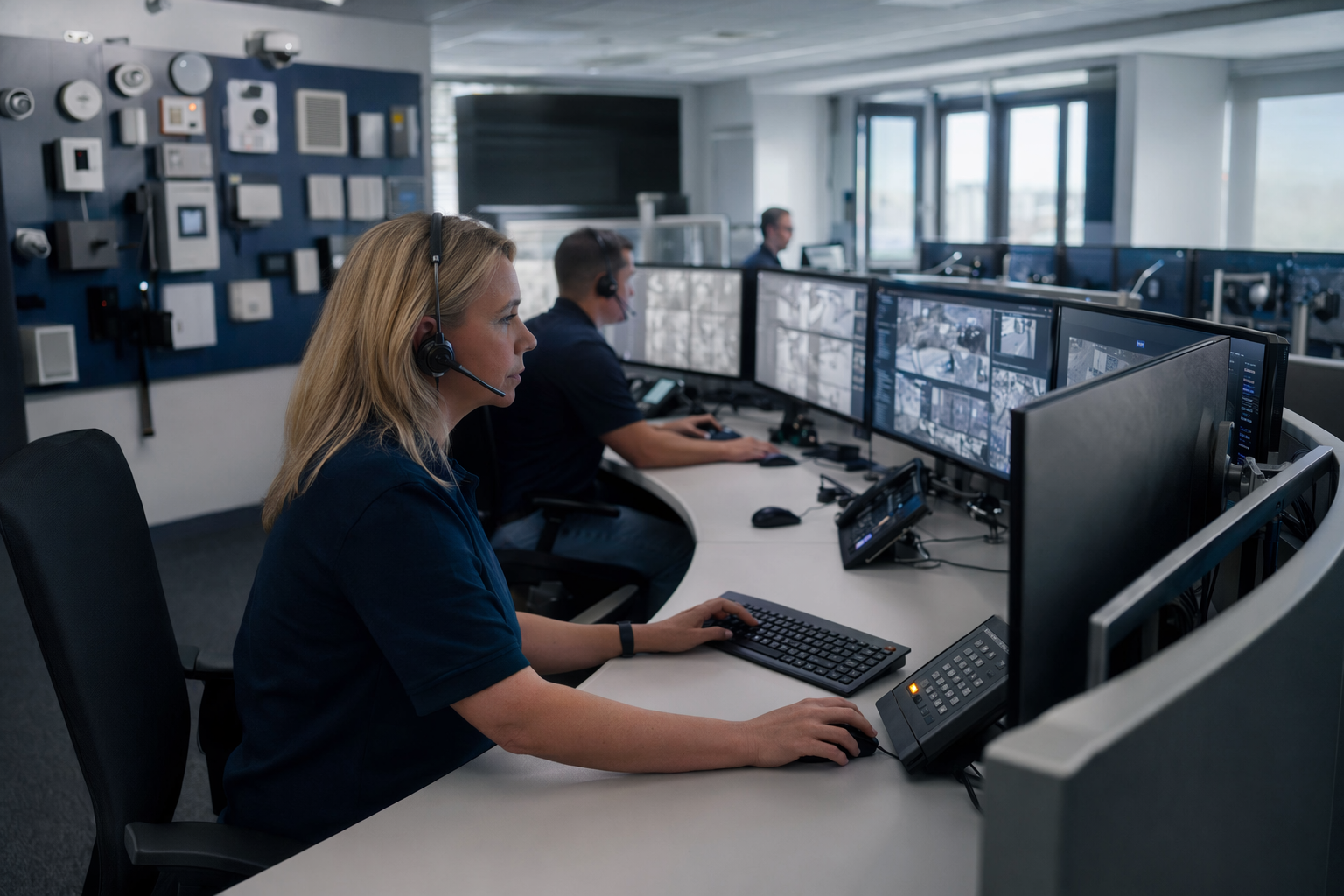
The basic signal path is simple. A sensor trips, the control panel sends a signal to the central station, a trained operator reviews it, tries a verification call when appropriate, then contacts police or fire if needed and notifies the customer. Line security and supervision focus on one part of that chain: whether the panel can still reach the central station at all.
Why it matters
A loud siren in the building is one thing. Central station monitoring is different. It depends on communication. If the alarm panel cannot reach the monitoring center, an intrusion, fire, panic, or trouble signal may never arrive.
That is why providers talk about cut phone lines, internet outages, dead backup batteries, weak cellular signal, and radio interference. Supervision does not stop those problems from happening. It helps detect them so the customer can be told there is a communication problem.
This also matters for false assumptions. Many people think "monitored" always means someone will know instantly if the line fails. Not always. Some systems only report when an event occurs. A supervised system is set to check in on a schedule, so a missed check-in can raise a trouble condition.
How supervised monitoring works in real life
Older systems often used a landline. If the phone line was cut, the panel might not be able to report alarms unless there was another path. Modern systems more often use cellular, internet, or dual-path communication. Dual-path usually means two ways to send signals, such as cellular plus broadband.
In a supervised setup, the alarm communicator sends regular signals to the central station. That might be every few minutes, every hour, or on another programmed interval. If the central station does not receive the expected check-in, the account can show a supervision loss, communication failure, or similar trouble signal.
What happens next depends on the account settings and the provider. A monitoring operator may call the customer or follow the provider's trouble procedures. That is different from dispatching police or fire for an actual alarm event. Trouble signals and alarm signals are not handled the same way.
If you are comparing plans, ask whether the communication path is supervised, how often it checks in, whether the system is single-path or dual-path, and what the provider does if a check-in is missed.
What line security does not mean
Line security does not mean a system is impossible to defeat. It does not mean police or fire will always be dispatched, and it does not guarantee any response time. It means the communication link is being watched in some way, so failures can be noticed.
It also does not mean every part of the system is supervised equally. Some sensors send regular supervision signals. Some hardwired zones are supervised differently. A siren, panel battery, cellular communicator, and internet router can each create separate trouble conditions. Ask for a plain list of what is supervised and what is not.
Be careful with sales language. "Full protection," "crash and smash proof," and similar claims are often too vague to be useful. Ask for specifics instead.
Questions to ask before you buy monitoring
If you are shopping for central station monitoring, ask direct questions and write down the answers. That helps you compare providers on the same facts.
Cost can vary a lot. Basic monitoring may start around $15 to $30 per month. Cellular or dual-path supervised monitoring is often more, sometimes around $25 to $60 or more per month depending on equipment, contract terms, and your area. Equipment, activation, permits, and service calls can add to the total. Those are ranges, not quotes.
Also watch for common alarm sales tactics: long auto-renewing contracts, "free" systems that lock you into costly monitoring, door-to-door pressure, and cancellation terms that are hard to find or hard to use. In some states, alarm-company solicitation is licensed and rules vary by state.
- Is the communication path landline, internet, cellular, or dual-path?
- How often does the system send supervision or heartbeat signals?
- What exact trouble signal appears if the panel misses a check-in?
- Will you call me for a supervision loss, and at what phone numbers?
- Are there permit requirements or false-alarm fees in my city?
- Does the contract auto-renew, and how do I cancel?
How Signal Watch Central can help
Signal Watch Central is not an alarm company, not a monitoring center, and not a UL-listed central station. We do not install or monitor systems, and we do not guarantee equipment or outcomes. We provide general education and help people find a monitoring provider near them.
If you want help comparing options, you can get matched with participating providers. If you choose to ask for contact, it happens only with your prior express written consent through an unchecked box you tick yourself. That consent is not a condition of using our free service, and you can opt out at any time.
A good next step is to read more on alarm monitoring basics and then compare providers using the same checklist. Plain questions usually get better answers.
Line security and supervised monitoring mean your alarm system checks that it can still talk to the central station, so a lost phone, internet, or cellular path can be noticed.
Common questions
Is line security the same as supervised monitoring?
They are closely related, but not exactly the same. Line security is the goal of detecting a lost communication path, while supervised monitoring is the check-in method used to detect that loss.
If my internet goes down, will my monitored alarm still work?
Maybe. If your system uses only broadband, an outage can interrupt alarm reporting. A cellular or dual-path communicator may keep signals going, depending on the equipment, programming, and signal conditions.
Does supervised monitoring mean the police are called if the line fails?
Usually no. A missed check-in or communication failure is normally treated as a trouble condition, not the same as a burglary or fire alarm. The provider may call you or follow its trouble procedures instead.
Do I need dual-path monitoring?
Not everyone chooses it, but many people prefer it because there are two communication paths instead of one. The right fit depends on your equipment, risk tolerance, budget, and what providers offer in your area.
How much does supervised alarm monitoring cost?
A rough range is about $15 to $30 per month for basic monitoring and about $25 to $60 or more for cellular or dual-path supervised monitoring. Real pricing depends on equipment, the monitoring contract, add-ons, and your area.
Can you set up or monitor my system for me?
No. Signal Watch Central is a free educational and matching service. We help you find a monitoring provider, but we do not install, monitor, or operate a central station.